Best Gantt Chart Software in 2026: 10 Tools Compared
Feature and pricing tables for Instagantt, GanttPRO, ProofHub, Smartsheet, Paymo, Wrike, TeamGantt, ClickUp, Microsoft Planner and monday.com, checked against each vendor's own pages






Disclosure: Instagantt is our product, and we list it first. To keep this comparison useful, every price and feature comes from each vendor's own pricing page or help center, checked on September 19, 2026, and each review says when another tool is the better choice.
How We Evaluated These Tools
We compared ten tools that offer a true Gantt chart, using the same checklist for each: which plan unlocks the Gantt view, which dependency types it supports, whether it has critical path, baselines, milestones, auto-scheduling and a workload view, how you can share a plan with people who have no account, and what the cheapest plan with a Gantt chart actually costs.
Every price and feature in this article comes from the vendor's own pricing page or help center, checked on September 19, 2026. Where a vendor does not document a feature, we say so instead of guessing. Promotional prices are flagged, because several vendors show discounted prices that later rise.
Instagantt is listed first because it is our product — see the disclosure above. The other nine are ordered by how complete their Gantt features are on the cheapest plan that includes a Gantt chart, not by popularity. Each review ends with who should choose that tool, including cases where it is a better fit than Instagantt.
We left out tools whose timeline view has no dependencies. Trello's Timeline has no built-in dependency management, and Toggl Plan has been folded into Toggl, whose timeline does not document dependencies. Both work for simple scheduling, but they are not Gantt chart software in the sense used here.
Feature Comparison at a Glance
The table below shows the plan where each core Gantt feature starts. The pattern is consistent across the market: the Gantt view is usually available on an entry plan, while critical path, baselines and workload views are reserved for a higher tier. Compare the tier, not just the checkmark, before you compare prices.
Dependencies deserve a closer look. Most tools support finish-to-start, which covers the majority of real schedules. Wrike, Microsoft Planner Plan 3 and monday.com's Pro plan support all four dependency types; Instagantt supports finish-to-start and start-to-start.
| Tool | Gantt view from | Dependencies | Critical path | Baselines | Workload | Read-only share link |
|---|---|---|---|---|---|---|
| Instagantt | Free (Asana version) | All plans | All plans | All plans | Teams | All plans |
| GanttPRO | Core | All plans | All plans | All plans | Business | All plans |
| ProofHub | Essential | Yes | Yes | Yes | Report on Ultimate Control | Not documented |
| Smartsheet | Pro | Pro | Pro | Business | Business | Business |
| Paymo | Pro | Pro, with lead and lag | Pro | Not documented | Pro | Not documented |
| Wrike | Team | All four types on Team | Business | Business | Business | Team |
| TeamGantt | Free (1 project) | Basic on all plans, advanced on Business | Business | Business | Business | Paid plans |
| ClickUp | Free (60 uses) | All plans | Business | Business | Business | All plans |
| Microsoft Planner | Plan 1 | Finish-to-start on Plan 1, all four types on Plan 3 | Plan 3 | Plan 3 | Plan 1 | Not documented |
| monday.com | Standard | Pro | Pro | Pro | Pro | Board owners can share a view |
Checked on each vendor's pricing page and help center on September 19, 2026. "Not documented" means we could not confirm the feature on the vendor's own pages.
Pricing Compared
Pricing models differ more than the headline numbers suggest. GanttPRO, Smartsheet, ClickUp, Wrike, Paymo and monday.com charge per user. TeamGantt charges per account and scales with the number of projects. ProofHub charges a flat monthly price with unlimited users. Instagantt sells a single-user plan and a flat Teams plan that includes three collaborators.
For a team of three, billed monthly, the cheapest plan with a Gantt chart costs $24 with Instagantt Teams, $27 with GanttPRO Core, $30 with ClickUp Unlimited, $36 with Smartsheet Pro and $42 with monday.com Standard. TeamGantt Basic is also $24, but it includes two projects and one manager. ProofHub's flat $50 becomes the cheapest option once a team grows past five or six people.
Where a vendor shows a promotional price, the table lists the regular price and notes the offer. Prices change often and can vary by country, so check the vendor's page before you buy.
| Tool | Pricing model | Monthly billing | Billed yearly (per month) | Free plan | Free trial |
|---|---|---|---|---|---|
| Instagantt | Individual (1 user) or Teams (flat, 3 users included) | $12; Teams $24 + $8 per extra user | $10; Teams $20 | Yes, for Asana users (3 projects, 1 user) | 7 days, no card |
| GanttPRO | Per user | $9 (Core) | $8 | No | 14 days, no card |
| ProofHub | Flat, unlimited users | $50 (Essential) | $45 | No | 14 days, no card |
| Smartsheet | Per member | $12 (Pro) | $9 | No | 30 days, no card |
| Paymo | Per user | $23.90 (Pro) | $16.90 | Yes, without a Gantt chart | 15 days, no card |
| Wrike | Per user, 2–15 users | Not listed | $10 (Team) | Yes, without a Gantt chart | 14 days, no card |
| TeamGantt | Flat per account | $24 (Basic, 2 projects) | $20 | Yes (1 project, 40 tasks) | 14 days, card required |
| ClickUp | Per user | $10 (Unlimited) | $7 | Yes (Gantt limited to 60 uses) | Not stated |
| Microsoft Planner | Per user | Not listed | $10 (Plan 1); $30 (Plan 3) | Basic Planner comes with Microsoft 365 | 1 month, card required |
| monday.com | Per seat, 3-seat minimum | $14 (Standard) | $12 (special offer) | Yes, without a Gantt chart | 14 days, no card |
Prices exclude tax and were taken from each vendor's pricing page on September 19, 2026. monday.com shows its yearly prices as a special offer, and Paymo currently discounts monthly Pro to $16.90 for the first three months. Prices change often and can vary by country.
1. Instagantt — Best for Small and Medium Teams
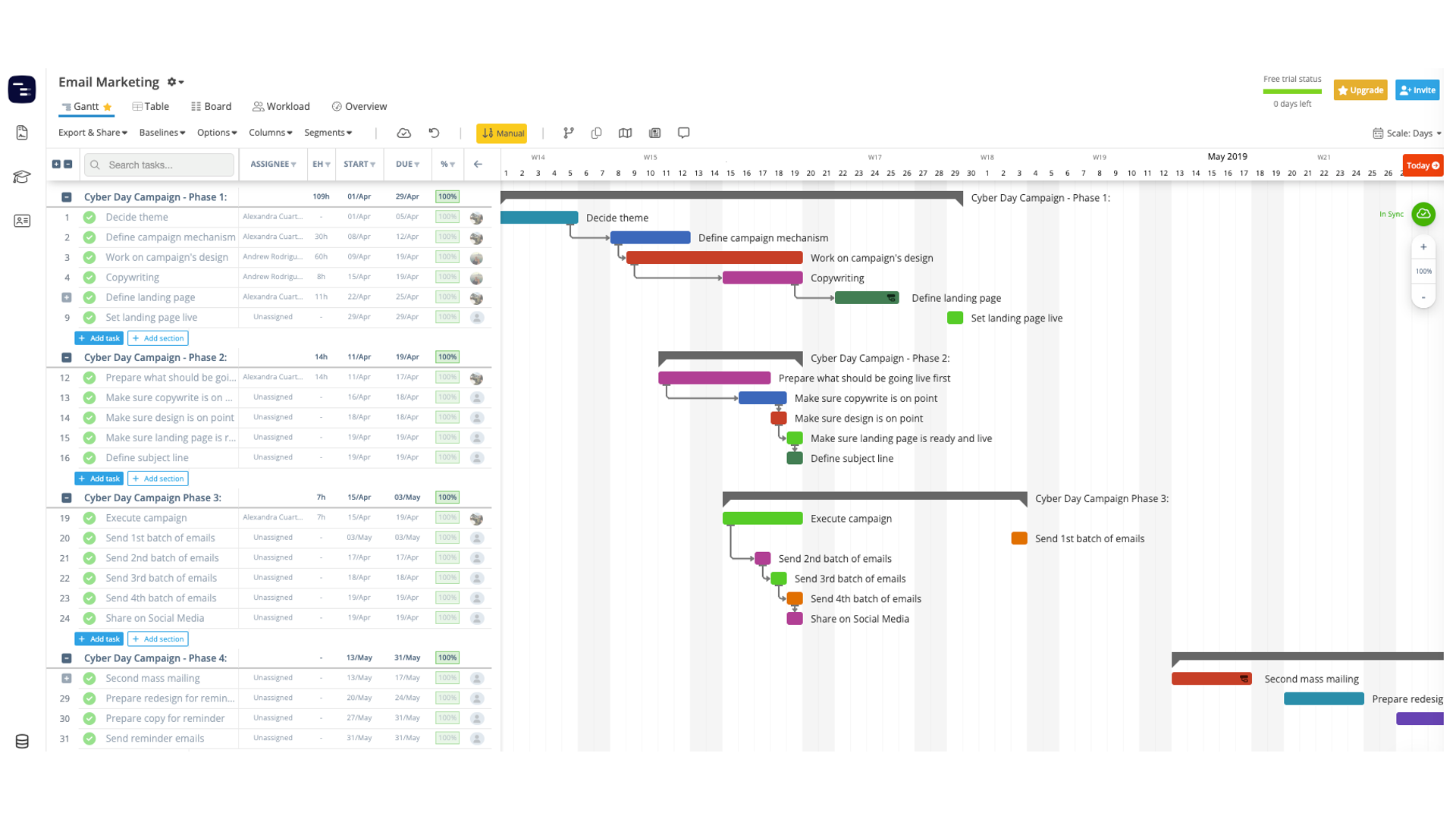
Instagantt is a dedicated online Gantt chart tool for small and medium teams. Founded in 2013 and used by more than 500,000 people, it does one thing instead of being an all-in-one workspace: you build the schedule by dragging bars on a timeline, not by filling in a table of dates. That focus is why we put it first for teams whose main job is planning and keeping a schedule honest, rather than running every kind of work in one platform.
Every account runs on the same Gantt engine: drag-and-drop scheduling, dependencies, milestones, critical path and baselines, with no Gantt feature held back for a higher tier. Two things stand out in this list. The AI Assistant turns a plain-English description of a project into a full schedule — tasks, dates and dependencies — which you then adjust by dragging, instead of starting from an empty grid, and it is part of the plan rather than a metered add-on. GanttPRO and TeamGantt ship a comparable generator; ClickUp charges for AI from $9 per user per month on top of the workspace plan, Microsoft requires a Plan 3 or Copilot licence, and the AI in Asana, Trello, Wrike and monday.com produces a task list or a board rather than a dated, dependency-linked schedule. The second is the public snapshot link, which gives clients and executives a live read-only view without an account: it is included on every plan, only GanttPRO and ClickUp match that here, and three of the ten tools do not document such a link at all.
It also runs in any browser, phones and tablets included, with nothing to install and no separate mobile version to keep in sync. The Teams plan adds workload management and the multi-project dashboard, and there is a two-way Asana sync for teams that keep their tasks there.
The Individual plan costs $12 per month, or $10 per month billed yearly. Teams costs a flat $24 per month ($20 billed yearly) for three collaborators, plus $8 per month for each additional one, so a team of five pays $40 per month against $45 with GanttPRO Core and $120 with monday.com Pro. Every paid plan has a 7-day free trial with no credit card, and Asana users can work free on up to three Asana projects.
Limitations: Instagantt supports finish-to-start and start-to-start dependencies, not all four types, and the free plan is the Asana version, which does not include the AI Assistant. Choose it if you are a small or medium team that wants a focused Gantt tool, an AI that drafts the first version of the plan and a flat team price; choose Wrike or Microsoft Planner Plan 3 if your schedules need finish-to-finish or start-to-finish links.
2. GanttPRO — Most Complete Gantt Features on the Entry Plan
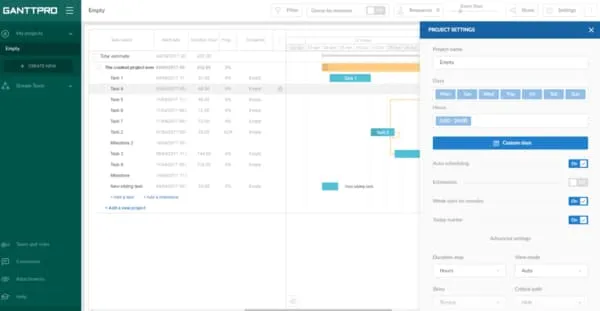
GanttPRO is a dedicated online Gantt chart tool, and it is unusually generous on its entry plan: dependencies, critical path, baselines, milestones and auto-scheduling are all included in Core. Workload management, portfolios, budgets and time tracking arrive on the Business plan.
Core costs $9 per user per month, or $8 billed yearly for teams of up to 15 ($7 for 20 or more members). Advanced costs $15 ($12 billed yearly) and Business $24 ($19 billed yearly). There is no free plan, but the 14-day trial needs no credit card. Plans can be shared through a link, exported to PDF, PNG, XML or Excel, and managed from native mobile apps.
GanttPRO has no Asana integration. Choose it if you want the most complete Gantt feature set at an entry price and do not need your plan synced with another task manager.
3. ProofHub — Flat Price for Unlimited Users
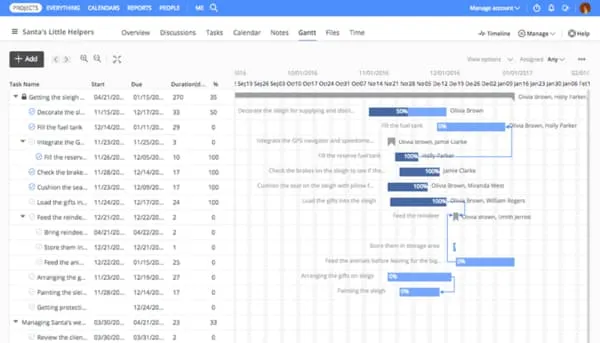
ProofHub is an all-in-one project management and collaboration suite with a flat monthly price and no per-user fees. Its Gantt chart, with dependencies, critical path, baselines, milestones and auto-scheduling, is included in both plans.
Essential costs $50 per month, or $45 per month billed yearly, for unlimited users and up to 40 projects, but it excludes reports, custom roles and workflows. Ultimate Control is advertised at $99 per month ($89 billed yearly) for the first three months, then $150 ($135 billed yearly), and it is the only plan with a workload report. There is a 14-day free trial and no free plan.
Choose ProofHub when a larger team needs Gantt charts alongside discussions, proofing and chat, and a flat price beats per-seat pricing. For a team of two or three, per-user tools cost less.
4. Smartsheet — Best for Spreadsheet-Style Planning
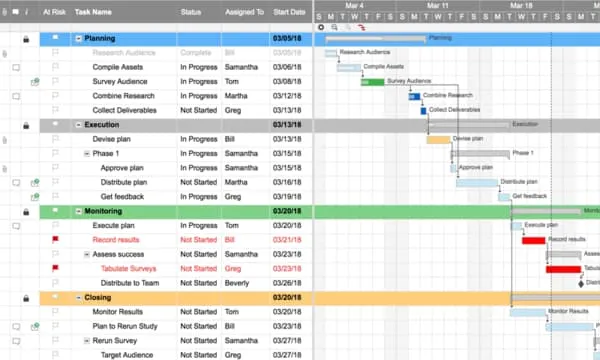
Smartsheet looks and works like a spreadsheet with a Gantt view on top. Pro includes the Gantt chart, dependencies, critical path, milestones and auto-scheduling. Baselines, workload tracking, the Timeline view and published read-only views require Business.
Pro costs $12 per member per month, or $9 billed yearly, for up to 10 members. Business costs $24 ($19 billed yearly) with a three-member minimum. There is no free plan, but the 30-day trial needs no credit card. Smartsheet exports to Excel, Google Sheets, Microsoft Project, PDF and image.
Smartsheet has no native Asana integration. Choose it if your organization already thinks in spreadsheets and needs enterprise controls and reporting.
5. Paymo — Best for Agencies That Track Time and Invoice
Paymo combines project management with time tracking, scheduling and invoicing, which makes it a natural fit for agencies and other project-based businesses. Its Gantt view, with dependencies (including lead and lag time), critical path, workload and auto-scheduling, is only available on the Pro plan.
Pro costs $23.90 per user per month, or $16.90 billed yearly, and Paymo currently offers the monthly plan at $16.90 for the first three months. The cheaper Solo and Plus plans do not include the Gantt chart, and the free plan is limited to one user and two projects. The trial lasts 15 days with no credit card.
Paymo does not document baselines or a public read-only link, and it has no Asana integration. Choose it when billing clients for tracked time matters as much as the schedule itself.
6. Wrike — Best for Resource Planning at Scale
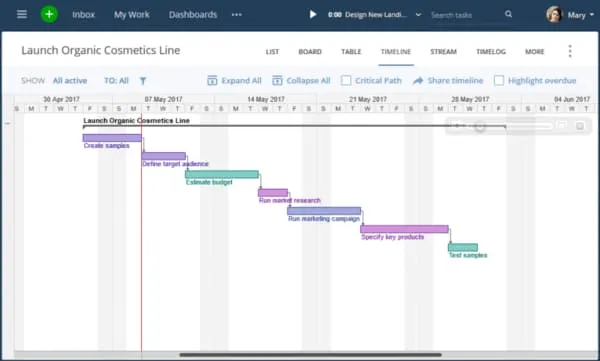
Wrike is a work management platform for mid-size and enterprise teams. Its interactive Gantt chart, on the Team plan and above, supports all four dependency types and auto-scheduling. Critical path, baselines and workload management start on Business.
Team costs $10 per user per month, billed yearly, for 2 to 15 users. Business costs $25 per user per month, billed yearly, for 5 to 200 users. Wrike does not list monthly billing. Its free plan has no Gantt chart, and the trial lasts 14 days with no credit card.
Wrike connects to Asana only through Wrike Sync, a paid add-on. Choose it if you need resource and capacity planning across many projects and teams.
7. TeamGantt — Best Per-Project Pricing
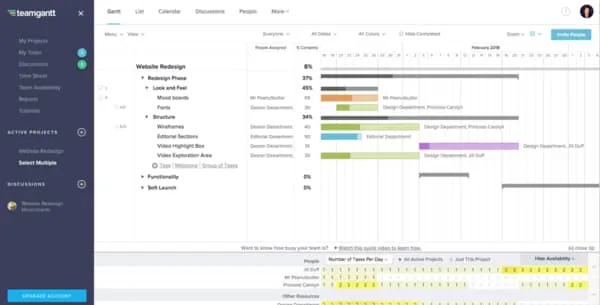
TeamGantt is a dedicated Gantt tool known for its simple drag-and-drop interface. It prices by account rather than by user and scales with the number of projects. Basic dependencies are available on every plan, including the free one; advanced dependencies, critical path, baselines and workload start on Business.
The free plan covers one user, one project and 40 tasks. Basic costs $24 per month, or $240 per year, for two projects, one manager and 10 collaborators, with extra projects at $12 per month each. Business costs $120 per month ($1,140 per year) for five projects and unlimited users, and the Builder Edition for construction teams starts at $199 per month. The 14-day trial requires a credit card.
Exports cover PDF, CSV and Microsoft Project files, and every paid plan can share a read-only link. The mobile app is a companion with a list view only, and there is no Asana integration. Choose TeamGantt if a few projects involve many collaborators.
8. ClickUp — Best Free Plan to Try a Gantt Chart
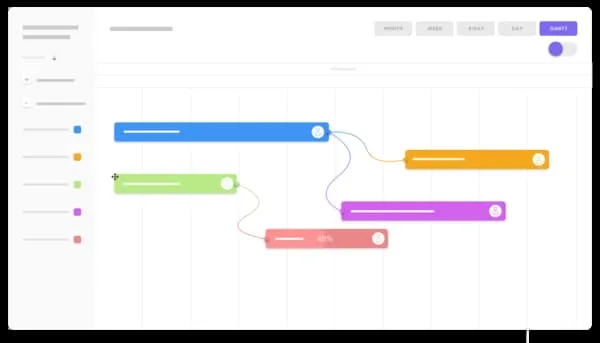
ClickUp is an all-in-one workspace for tasks, docs, chat and AI, with Gantt as one of many views. Its free plan includes the Gantt view, capped at 60 uses, which is enough to test it on a real project.
Unlimited costs $10 per user per month, or $7 billed yearly, and removes the Gantt limit. Critical path, baselines, unlimited workload views and Gantt export to PDF or PNG require Business, at $19 per user per month ($12 billed yearly). Dependencies are available on every plan, and AI features are paid add-ons.
ClickUp can import from Asana once but does not sync with it. Choose ClickUp if you want to replace several tools with one and can live with a busier interface than a dedicated Gantt tool.
9. Microsoft Planner and Project — Best for Microsoft 365 Organizations
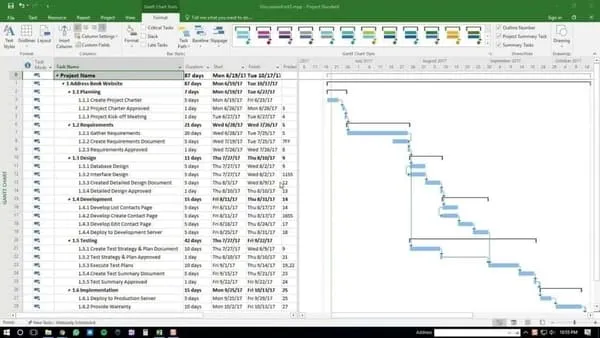
Microsoft's lineup has changed. Project for the web was retired in August 2025 and folded into Planner, and Project Online retires on September 30, 2026. Today Microsoft sells Planner Plan 1, Planner and Project Plan 3, and the Project Standard 2024 and Project Professional 2024 desktop apps.
Planner Plan 1 costs $10 per user per month, billed yearly, and includes a timeline with finish-to-start dependencies and a People view for workload. Plan 3, at $30 per user per month billed yearly, adds critical path, baselines, all four dependency types with lead and lag, and the Project desktop app. Project Standard 2024 is a one-time purchase at $679.99 per user and PC, and Project Professional 2024 costs $1,129.99. The trial lasts one month and requires a credit card.
Choose Microsoft if your organization already runs on Microsoft 365 and Teams, or if you need desktop project scheduling. For teams outside Microsoft's ecosystem, the web tools above are simpler and cheaper.
10. monday.com — Best Work Management Platform with a Gantt View
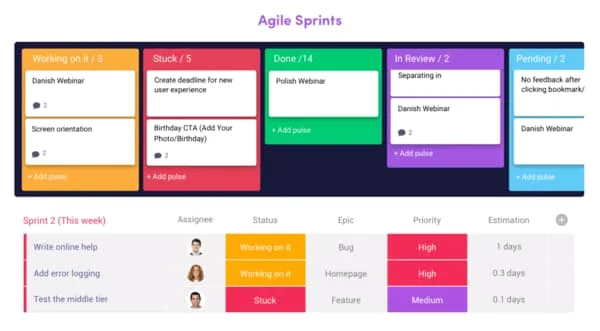
monday.com is a customizable work management platform where Gantt is one of several board views. The Gantt view starts on the Standard plan, but a Standard Gantt chart has no dependencies: dependencies, critical path, baselines, milestones, workload and auto-scheduling all require Pro.
Standard costs $14 per seat per month, or $12 billed yearly under a special offer, and Pro costs $24 ($19 billed yearly under a special offer). Plans start at three seats. The free plan covers two seats and three boards, without a Gantt view, and the trial lasts 14 days with no credit card.
monday.com connects to Asana through an integration recipe on Standard and above. Choose it if your team wants one flexible platform for many kinds of work and the Gantt chart is a secondary view.
How to Choose the Right Gantt Chart Software
Start with the size and shape of your team. A small or medium team that mainly needs a schedule is better served by a dedicated Gantt tool such as Instagantt or GanttPRO than by an all-in-one platform where the Gantt chart is one view among many. If your company already runs on Microsoft 365, Planner is in your stack; if your tasks live in Asana, pick a tool that syncs with it so you do not keep two lists.
Then decide which features you need on day one. If you need critical path and baselines on a budget, GanttPRO includes them on its entry plan. If you only need to visualize a schedule, the entry plan of most tools is enough.
Finally, price your actual team. Per-user plans are cheapest for small teams, TeamGantt's per-project pricing suits a few projects with many collaborators, and ProofHub's flat price wins for large teams. Use the free trials: two weeks on a real project will tell you more than any comparison table, including this one.
Final Verdict
There is no single best Gantt chart software for every team. Instagantt is our pick for small and medium teams: a focused Gantt tool at a flat team price, with the AI planner and the public snapshot link that we think make the first hour and the weekly update easier than the alternatives here. GanttPRO has the most complete Gantt features on an entry plan, Microsoft Planner is the natural choice inside Microsoft 365, and ClickUp is the easiest way to try a Gantt chart for free.
Whichever you pick, check the plan that unlocks the features you need — critical path and baselines are rarely on the cheapest tier — and re-check prices before you buy, since several vendors run promotions.
Frequently Asked Questions
Start Building Better Project Plans Today
7 day free trial. No Credit Card needed.
Instagantt is online Gantt chart software for planning projects with timelines, dependencies, and team workload.